

Sheet D-03 · Develop
Web Application Development in Hyderabad
Not every business needs a SaaS platform — but every growing operation eventually outgrows spreadsheets, WhatsApp coordination, and off-the-shelf tools. We build production-grade web applications for hospitals, clinics, and growing businesses across Hyderabad: appointment and booking systems, patient and customer portals, operational dashboards, and internal tools. The same engineering discipline as funded-startup software, applied to the workflows your business actually runs — and integrated with the payment, accounting, and messaging systems you already use.
Sheet D-03 · Contents
1.1 · The Problem
Your Operations Run on Spreadsheets, WhatsApp, and Workarounds
Small and medium businesses — and most hospitals — force-fit their operations into software designed for someone else, or into no software at all. The result is manual workarounds, data silos, and processes that break at exactly the moment you grow.
- 01Appointment books managed through phone calls, paper registers, and WhatsApp messages — with no-shows unmanaged and no record of the patient journey after the visit
- 02Critical business logic living in spreadsheets that break, get overwritten, and cannot be safely used by more than one person at a time
- 03Paying for ten SaaS subscriptions that do not talk to each other, creating fragmented data and duplicate manual entry across billing, CRM, and operations
- 04Monthly reports assembled by hand from exports, so decisions are made on stale, incomplete data instead of a live view of the business
- 05Patient- and customer-facing processes running on generic tools that offer no brand experience and cannot be adapted to how your operation actually works
1.2 · Our Framework
Custom Software, Enterprise Methodology
We apply enterprise-grade engineering practices to small and medium business software — because a hospital front desk or a growing operations team deserves the same quality of tooling as a funded startup, without the funded-startup budget.
Booking & Scheduling Systems
Appointment booking for hospitals and clinics, service booking for local businesses: slot management mapped to how doctors and teams actually work, automated reminders via WhatsApp and SMS to cut no-shows, and a front-desk view that replaces the paper register without slowing anyone down.
Patient Portals & Customer Portals
Secure logins where patients access reports, prescriptions, and visit history, and customers track orders, documents, and payments. Role-based access control, audit logging, and consent-aware data handling are designed in at the schema level, not patched on later.
Dashboards & Internal Tools
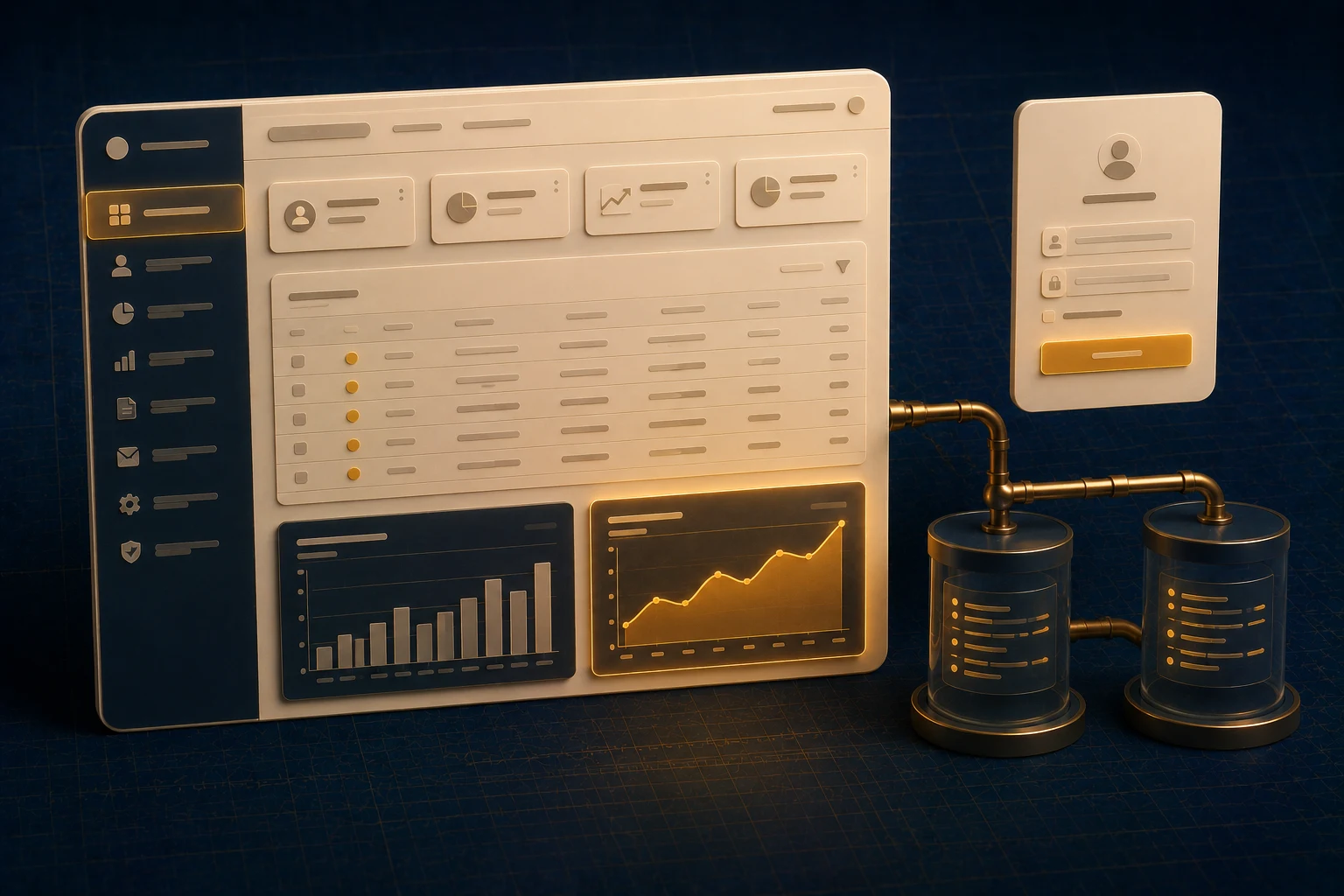
Operational dashboards that consolidate your business data into a single live interface — occupancy, revenue, pipeline, inventory, team workload. Purpose-built admin panels replace the spreadsheets, giving management real-time numbers instead of month-old exports.
API Development & Integrations
RESTful and GraphQL APIs that connect your systems: Razorpay payments, WhatsApp Business API notifications, accounting sync with Tally or Zoho Books, lab and hospital information systems, and any third-party service your workflow depends on — each built with retry logic and failure handling.
Architecture, Database & DevOps
Properly normalized PostgreSQL schemas designed for integrity and future scale, CI/CD pipelines, automated testing, staging environments, and reliable deployment on AWS, Vercel, or Railway. Your software ships predictably with every update — no more spreadsheet databases, no more manual deploys.
2.1 · Our Process
From Workflow Mapping to Production in 8-16 Weeks
| Stage | Phase | Detail |
|---|---|---|
| 01 | Requirements & Workflow Mapping | We sit with the people who run the process today — front desk, operations, billing, management — and map the current workflow end to end. Deliverable: a functional specification with data models, user roles, and the automation opportunities ranked by impact. |
| 02 | Architecture & Data Model Design | Database schema, permission model, and integration contracts are designed before any interface is built. Every entity, role, and system boundary is documented so the software matches your operational reality instead of forcing a new one. |
| 03 | Design & Prototyping | Interactive Figma prototypes validated with the people who will use the system daily. A booking screen that confuses the front desk fails in prototype review, where fixing it costs hours — not in production, where it costs adoption. |
| 04 | Agile Development Sprints | Two-week sprint cycles with deployable increments and a demo to your team every sprint. You see working software every two weeks and can re-prioritize based on what real usage reveals, not what the original spec assumed. |
| 05 | Testing, Data Migration & UAT | Comprehensive QA — unit, integration, and user acceptance testing — alongside custom migration scripts that extract, clean, and validate data from your existing spreadsheets and tools. We run parallel systems during transition so nothing is lost. |
| 06 | Deployment, Training & Retained Development | Staged rollout with hands-on training for your staff and documented playbooks for every role. Post-launch, most clients move to a development retainer: new features prioritized from real usage, performance monitoring, and infrastructure management handled for you. |
3.1 · Technology Stack
Built With Industry-Leading Tools
We leverage proven, scalable technologies to deliver enterprise-grade results.
- React
- Next.js
- TypeScript
- Node.js
- NestJS
- Python
- Django
- PostgreSQL
- MongoDB
- Redis
- Prisma
- Docker
- AWS
- Razorpay
4.1 · Expected Outcomes
Measurable Results, Not Promises
Real metrics from real client engagements, demonstrating the impact of our engineering approach.
Manual Work Replaced by Software
Every build targets the hours your team currently spends on data entry, reminder calls, report assembly, and follow-ups — engineered so the software does the repetitive work and your staff handle the judgment calls.
One System of Record
A single, properly designed database becomes the source of truth for your operation. Front desk, operations, and management all work from the same live data — eliminating the reconciliation errors that fragmented tools guarantee.
Usable Software Every Two Weeks
Structured sprint methodology delivers deployable increments from the first sprint and production-ready systems in 8 to 16 weeks depending on scope — so value arrives during the build, not only at the end of it.
Built to Integrate, Not Rip and Replace
The system connects to the payments, accounting, and messaging tools you already run — Razorpay, Tally, WhatsApp — so adoption means removing manual steps, not retraining your entire operation on day one.
5.1 · FAQ
Web Apps & Portals Questions
Answers to the questions we hear most from prospective clients.
Is custom software affordable for a clinic or small business?
Yes, when scoped correctly. Focused web applications start from ₹4,00,000, with larger multi-role systems scaling from there. The comparison that matters is total cost of ownership: add up what you pay across SaaS subscriptions that only half-fit, plus the staff hours spent on manual entry, reconciliation, and report assembly. Custom software built around your actual workflow frequently costs less over three years than that combined stack — while doing the job properly. We scope a minimum viable system first, so you are never paying for features before the core workflow has proven itself.
How do you handle patient data and privacy?
As an architecture requirement, not an afterthought. India's Digital Personal Data Protection Act (DPDP) makes consent, purpose limitation, and security obligations explicit for anyone handling personal data — and health data warrants the strictest treatment. We design for this at the schema level: role-based access control so staff see only what their role requires, audit logs of who accessed what, encryption in transit and at rest, hosting in Indian cloud regions, and consent and deletion flows built into the portal itself. You get a system you can defend, not one you have to apologize for.
How do you migrate data from our existing spreadsheets and tools?
Data migration is included in every project scope. We build custom migration scripts that extract data from your existing tools — spreadsheets, CRMs, accounting software, legacy databases — then clean, deduplicate, and normalize it before importing into the new system with full validation. We run both systems in parallel during the transition period and reconcile the outputs, so cutover happens only when the new system has proven it holds the complete, correct picture. Zero data loss is a process guarantee, not a hope.
What happens if we need changes or new features after launch?
Software is never done, and we structure for that. Ongoing development retainers start at ₹75,000 per month and include feature development, bug fixes, performance monitoring, and infrastructure management. The pattern that works: launch a core system covering the highest-impact workflow, run it for two to three months, then expand based on what real usage data shows your team actually needs — which is reliably different from what anyone predicted in the first requirements meeting.
Get Started
Ready to transform your Web Apps & Portals?
Book a free 30-minute strategy call. We will audit your current setup, identify the highest-impact opportunities, and map out a clear path to measurable results.